
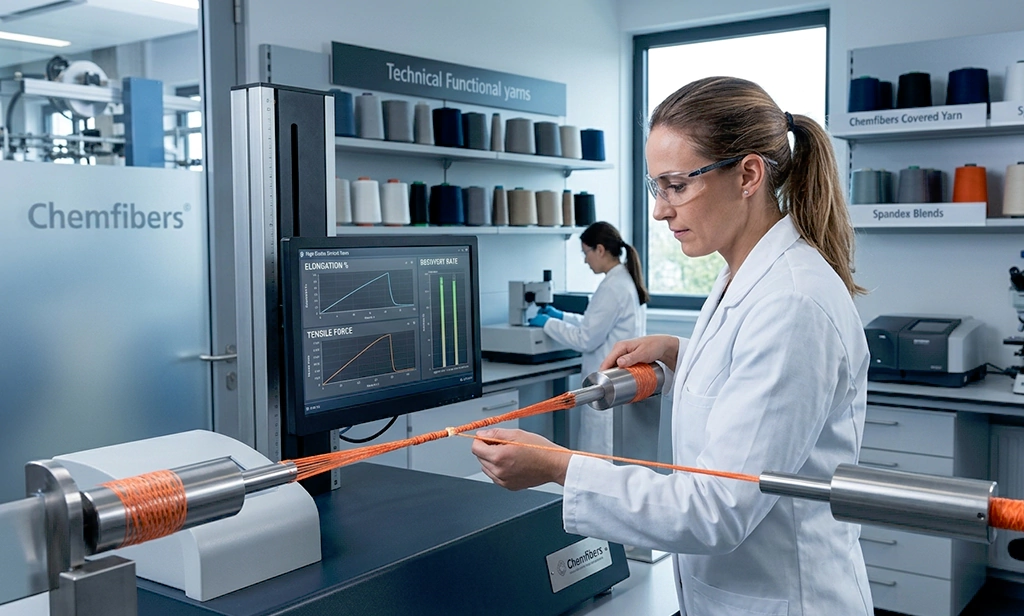
Chemfibers: High-Performance Elastic Stretch Yarn Solutions

In the competitive landscape of the global textile industry, “stretch” has evolved from a functional luxury into a fundamental requirement. From the high-performance compression gear worn by elite athletes to the everyday comfort of seamless intimate apparel, High Elastic Stretch Yarns are the invisible architects of modern garment functionality.
For sourcing managers and product developers, understanding the technical nuances of these yarns is critical to ensuring product longevity and consumer satisfaction. At Chemfibers, we leverage decades of manufacturing expertise to demystify the complexities of high-stretch fibers.
1. What Defines “High Elastic” in Technical Textiles?
Not all stretch is created equal. High elastic yarns are engineered to provide two distinct mechanical properties: Elongation (the ability to stretch under tension) and Recovery (the ability to return to the original length without permanent deformation).
Typically, these yarns are achieved through two primary methods:
- Material Selection: Using inherently elastic polymers like Spandex (Elastane).
- Mechanical Texturizing: Utilizing the thermoplastic nature of Polyester or Nylon to create “crimp” through Draw Textured Yarn (DTY) processes.
2. Deep Dive: Types of High Elastic Stretch Yarns
A. Covered Yarns (Spandex Core)
This is the gold standard for high-performance stretch. A core of spandex is wrapped with a skin of Nylon or Polyester.
- Single Covered Yarn (SCY): Offers a softer hand-feel and lighter weight, ideal for hosiery and fine knits.
- Double Covered Yarn (DCY): Provides superior durability and balanced tension, making it the preferred choice for medical compression stockings and high-end denim.
B. High-Crimp DTY (Mechanical Stretch)
By optimizing the twist and heat-setting parameters during the DTY process, we can produce High-Stretch Polyester or Nylon 6/66 without using spandex.
- The Advantage: Higher durability and better resistance to chlorine and aging compared to spandex-based alternatives.
C. PBT and T400 Fibers
These specialized polyester variants offer a “spring-like” molecular structure, providing excellent recovery and a more natural, cotton-like feel while maintaining high elasticity.
3. Engineering for Application: Where Performance Meets Fabric
Choosing the right high-elastic yarn requires a deep understanding of the end-use.
Activewear & Athleisure
In the world of yoga pants and running tops, the yarn must handle constant dynamic movement. High elastic yarns in this sector must prioritize Power Recovery—ensuring the fabric doesn’t “bag out” at the knees or elbows after repeated use.
Medical & Orthopedic Textiles
Compression is a science. Our high-stretch solutions for medical use are tested for Graduated Tension Control, ensuring that venous return is supported through precise pressure gradients.
Seamless Technology
High-elastic yarns are the backbone of seamless knitting. The consistency of the yarn’s shrinkage and stretch is what prevents sizing inconsistencies in the final garment.
4. Technical Metrics for Quality Evaluation
When sourcing High Elastic Stretch Yarns, a “trusted” supplier should provide data on the following:
- Stretch Force & Recovery Rate: Measured using constant-rate-of-extension (CRE) testers. A high-quality yarn should maintain >95% recovery after 100 cycles of 50% extension.
- Elastic Modulus: This determines the “stiffness” of the stretch. It dictates whether a garment feels like a “second skin” or a “restrictive shell.”
- Oil Content Consistency: Elastic yarns often require specific spin-finishes to run smoothly on high-speed knitting machines. Inconsistent oiling leads to uneven tension and fabric defects.
5. The Sustainability Frontier
The European and North American markets are increasingly demanding eco-friendly stretch solutions. Chemfibers is at the forefront of this shift, offering GRS-Certified Recycled High-Stretch Yarns. By combining recycled PET chips with advanced texturizing technology, we provide the same high-performance metrics while reducing carbon footprints and diverted plastic waste.
6. Why Supply Chain Integrity Matters
High-stretch yarns are notoriously sensitive to production fluctuations. A slight change in temperature during the texturizing oven can alter the elasticity of an entire batch.
This is why Chemfibers maintains:
- Integrated Manufacturing: We control the process from polymer selection to the final winding.
- On-Site Testing Labs: Every lot is tested for elongation and crimp stability before shipment.
- Bespoke Customization: We don’t just sell yarn; we develop specific elastic profiles based on your fabric construction.
Conclusion
The future of textiles is flexible. As consumer demand for “performance-comfort” grows, your choice of High Elastic Stretch Yarns becomes your most significant competitive advantage. By partnering with a manufacturer that prioritizes technical precision and supply chain transparency, you ensure that your products don’t just stretch—they perform.
Empower your next collection with Chemfibers. Contact our R&D team today to request technical data sheets or bespoke samples for your high-stretch requirements.
