
Evaluating High-Performance Functional Yarns

In the fast-evolving global textile market, sourcing high-performance functional yarns is no longer just about finding the lowest price—it’s about ensuring technical consistency, durability, and innovation. Whether you are developing high-compression activewear or specialized medical textiles, the quality of your raw material determines the success of your final product.
As a leading integrated manufacturer, Chemfibers understands that global buyers face a significant challenge: distinguishing between high-value functional fibers and low-cost, substandard alternatives. This guide provides a technical roadmap for evaluating Functional Yarn Quality and explains why internal testing protocols are the backbone of a reliable supply chain.
1. Defining High-Performance: More Than Just a Fiber
Functional yarns, such as modified Nylon and Polyester, are engineered to provide specific benefits: moisture-wicking, UV resistance, anti-bacterial properties, or extreme durability. Unlike commodity yarns, functional yarns require precise molecular control during extrusion and texturizing.
When sourcing globally, “Functional” should never be a vague marketing term. It must be backed by measurable physical metrics.
2. Key Physical Indicators of Yarn Quality
To ensure your textile production runs smoothly with minimal downtime, your quality control (QC) team must focus on four critical technical pillars:
A. Tensile Strength and Breaking Elongation
Tensile Strength is the maximum stress a yarn can withstand before breaking. For high-speed knitting or industrial sewing, high tenacity is non-negotiable.
- Why it matters: Low-tenacity yarn leads to frequent breakages on the loom, increasing factory waste and reducing efficiency.
- The Chemfibers Standard: We ensure each batch maintains a narrow variance in breaking elongation, providing the “stretch and recovery” essential for performance apparel.
B. Color Fastness and Dyeing Uniformity
For premium brands, color consistency is the most visible sign of quality. Color Fastness (to light, perspiration, and washing) is a major pain point in synthetic fiber sourcing.
- Dyeing Affinity: Inferior yarns often have uneven polymer density, leading to “barré” effects (unwanted stripes) in the finished fabric.
- Testing: We utilize spectro-photometric analysis to ensure Delta E values remain within strict commercial tolerances.
C. Thermal Stability and Shrinkage
Functional yarns often undergo high-heat treatments during dyeing or printing. If the thermal shrinkage is inconsistent, the final fabric dimensions will distort.
- Evaluation: Quality yarns should exhibit minimal and predictable boiling water shrinkage, ensuring the garment retains its shape after multiple domestic washes.
D. Moisture Management and Cross-Sectional Integrity
For moisture-wicking yarns, the shape of the fiber cross-section (e.g., “X” or “Y” shapes) is vital. If the extrusion process is inconsistent, the capillary action—which pulls sweat away from the skin—will fail.
3. The “Hidden” Risks of Low-Cost Sourcing
In the global supply chain, a “cheap” quote often comes with hidden costs that erode your profit margins:
- Weight & Yardage Discrepancies: Many traders overstate the net weight of the yarn or include the weight of the heavy paper tube in the price.
- Invisible Defects: Knotless yarn is essential for modern machinery. Low-quality suppliers often hide knots within the cone, causing catastrophic machine failures later.
- Chemical Compliance: Substandard fibers may contain restricted substances (like Azo dyes or heavy metals) that fail European REACH or Oeko-Tex standards.
4. How Chemfibers Ensures Excellence: Our In-House Lab
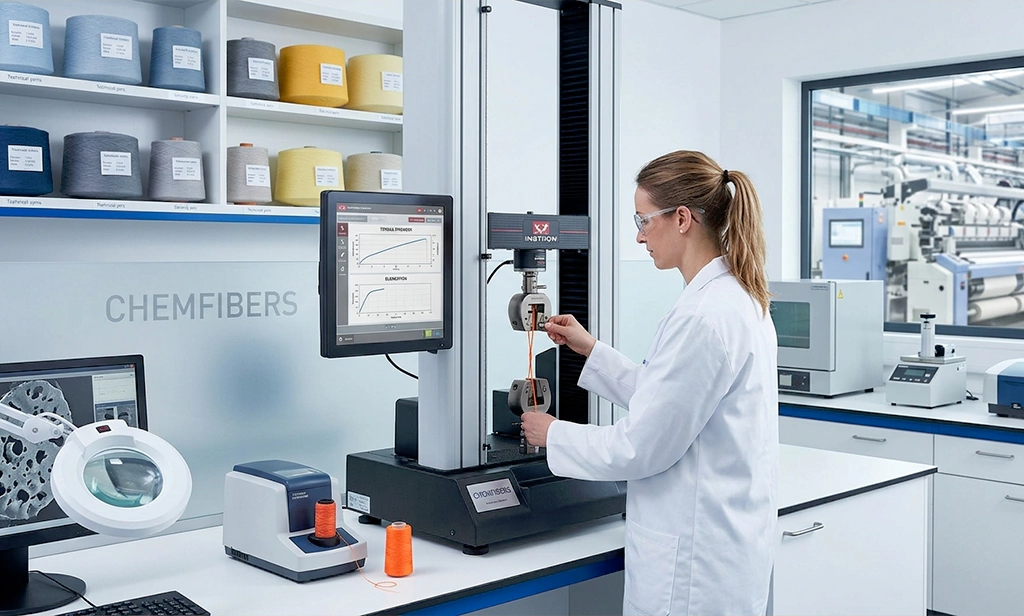
At Chemfibers, we believe that quality should be proven, not promised. Our integrated manufacturing facility features a state-of-the-art testing laboratory equipped with advanced inspection tools:
- Pre-Production Testing: We test raw polymer chips before extrusion to ensure chemical purity.
- During-Production Monitoring: Real-time tension and denier monitoring during the drawing and texturizing process.
- Post-Production Validation: Every batch undergoes rigorous Synthetic Fiber Testing, including tenacity, oil content, and shrinkage analysis, before it leaves our facility.
By maintaining 100% transparency in our testing data, we provide our global partners with the confidence that the “Chemfibers” tag stands for uncompromised integrity.
5. Conclusion: Build Your Brand on Quality
The global textile industry is shifting toward high-value, differentiated products. To compete, your sourcing strategy must prioritize technical performance over short-term price gains. By focusing on Tensile Strength, Color Fastness, and rigorous Synthetic Fiber Testing, you protect your brand reputation and optimize your production costs.
Looking for a partner who speaks the language of technical excellence? Explore our range of high-performance Nylon and Polyester solutions at [YourWebsiteURL.com] or contact our technical team for a bespoke consultation.
